
Power Banks & Portable Battery
Convert the badge into watt-hours before you believe anything: Wh = mAh x 3.7 / 1000. That puts a real 10,000mAh bank at 37Wh, a 20,000mAh at 74Wh and a 27,000mAh at just under the 100Wh airline carry-on limit. Anything printed above 27,000mAh that still fits in a pocket is either a lie or a 3.7V cell count stretched across marketing. The second number to check is output wattage: 20W tops up a phone, 45-65W is what a laptop needs.
What decides the purchase
- Capacity in Wh
- The number airlines and physics use. 37Wh pocket, 74Wh day bag, up to 100Wh carry-on legal
- Output power
- Decides whether it can run a laptop at all. 20-22.5W phone only, 30W tablet, 45-65W laptop, 100W+ work laptop
- Ports
- Shared budgets apply here too. One USB-C PD in/out plus one USB-A is the useful minimum
- Recharge speed
- A big bank that takes 8 hours to refill is dead weight on a trip. 18W in is slow, 45-65W in refills 20,000mAh in about 2 hours
- Pass-through
- Charge the bank and a phone from one wall socket. Not all banks allow it; those that do often throttle output
Our rule of thumb
Pick the smallest Wh that covers your longest day without a socket, then make sure the USB-C port is rated for the device you care about. For travel, a 20,000mAh 65W bank replaces a laptop charger entirely.
Convert the badge into watt-hours before you believe anything: Wh = mAh x 3.7 / 1000. That puts a real 10,000mAh bank at 37Wh, a 20,000mAh at 74Wh and a 27,000mAh at just under the 100Wh airline carry-on limit. Anything printed above 27,000mAh that still fits in a pocket is either a lie or a 3.7V cell count stretched across marketing. The second number to check is
Showing all 2 results
-
Power Banks & Portable BatteryView buying decision
Power bank 10000mAh MagSafe Powerbank iPhone 10000mAh Magnetic Powerbank 15W Wireless Power bank PD 20W Fast
Catalog price · Nov 9, 2026 Original price was: $46.00.$23.00Current price is: $23.00. -
Power Banks & Portable BatteryView buying decision
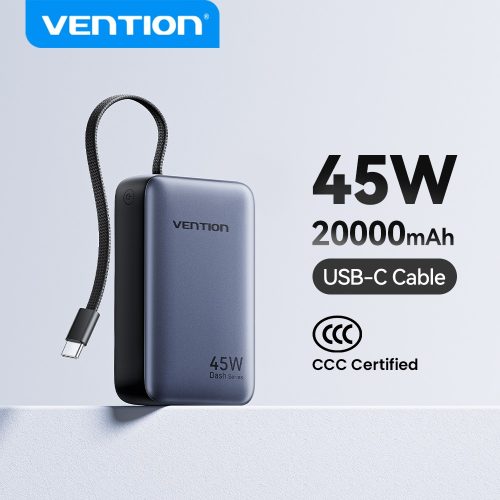
Power Bank 20000mAh Vention CCC 45W 20000mAh Power Bank Fast Charging Portable Charger
Catalog price · Nov 9, 2026 Original price was: $89.99.$32.99Current price is: $32.99.

Selection rule behind these listings: at least 200 recorded orders, buyer rating 4.5+, inside the category price band — ranked by order volume × rating ÷ price. See all 16 categories · method.